
The V2MOM Framework: How To Align Your Whole Company on One Page
Key Takeaways
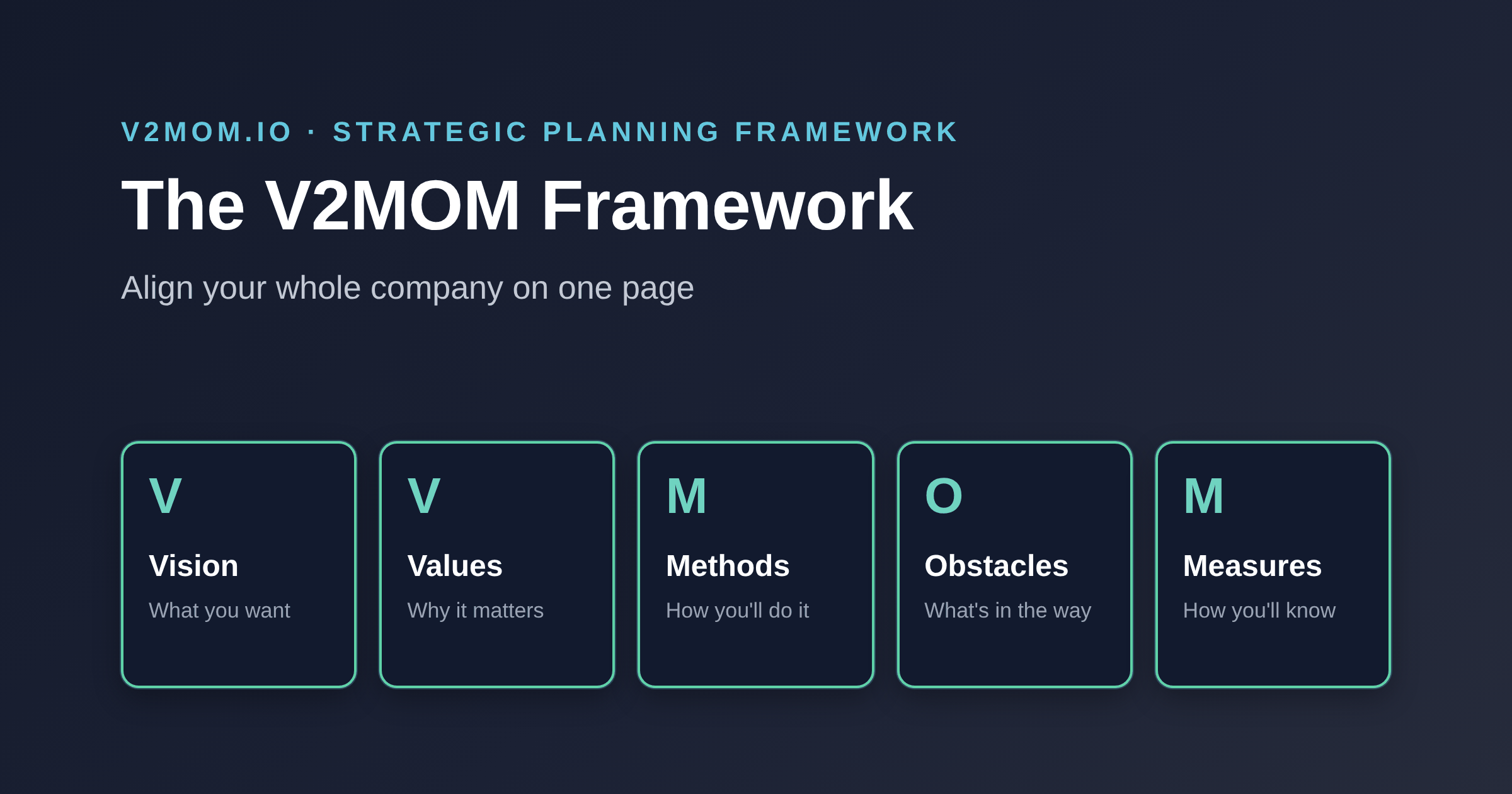
- •Vision: What you want to achieve, in one clear sentence.
- •Values: The principles that guide you, ranked in priority order.
- •Methods: The prioritized actions that turn vision into progress.
- •Obstacles: The challenges you name up front so they don't blindside you.
- •Measures: The specific, numeric results that prove you succeeded.
Most strategic plans fail for the same reason: nobody can remember them. They live in a 40-slide deck that gets presented once and never opened again. The V2MOM framework, created by Salesforce founder Marc Benioff, fixes this by forcing your entire strategy onto a single, ordered page that everyone in the company can read, understand, and act on.
This guide explains what a V2MOM is, walks through all five parts with an example, compares it to OKRs, and shows you how to write your own.
What Is a V2MOM?
V2MOM stands for Vision, Values, Methods, Obstacles, and Measures. It is a strategic planning framework that captures an organization's — or an individual's — plan in five ordered sections that answer five questions:
- Vision — What do you want to achieve?
- Values — What's important about it?
- Methods — How will you get it done?
- Obstacles — What's standing in your way?
- Measures — How will you know you've succeeded?
The order matters. Each section builds on the one before it, so by the time you reach Measures, everything traces back to the original Vision.
Where Did the V2MOM Come From?
The V2MOM was created by Marc Benioff, co-founder and CEO of Salesforce, in the company's earliest days. Benioff has said he wrote the first V2MOM on the back of an envelope, and Salesforce has used the framework to align its people ever since — from a handful of employees to a global company with tens of thousands. Every Salesforce employee's V2MOM ladders up to the company's, creating alignment from the CEO to the newest hire.
The 5 Parts of a V2MOM, Explained
1. Vision — What You Want
Your Vision describes what you want to achieve, in plain language. A good Vision is ambitious but clear enough that anyone reading it understands the destination.
Example: "Become the tool every team reaches for when they need to turn strategy into aligned action."
For a deeper walkthrough, see our ultimate guide to vision development with V2MOM.
2. Values — What's Important About It
Values are the principles that guide how you pursue the Vision, listed in priority order. When two priorities conflict, the order tells your team which one wins.
Example: 1) Customer trust, 2) Simplicity, 3) Speed of execution.
3. Methods — How You'll Get It Done
Methods are the concrete actions you'll take — the initiatives, projects, and steps that move you toward the Vision. Keep them ordered by priority so effort goes to what matters most.
Example: 1) Ship the collaborative planning editor, 2) Launch the template library, 3) Build the alignment dashboard.
4. Obstacles — What's in the Way
Obstacles are the challenges you expect to face. Naming them up front turns hidden risks into planned-for realities — and signals to your team that leadership sees the road clearly.
Example: Limited engineering capacity; low awareness of the V2MOM framework outside Salesforce.
5. Measures — How You'll Know You Succeeded
Measures are the specific, numeric results that prove you achieved the Vision. If a Measure is hit, there should be no debate about whether you succeeded.
Example: 10,000 active plans created; 40% month-over-month growth in team sign-ups.
V2MOM Example (Filled Out)
Here's a compact V2MOM for a fictional product team:
- Vision: Make quarterly planning something teams actually look forward to.
- Values: 1) Clarity, 2) Collaboration, 3) Accountability.
- Methods: 1) Replace the planning doc with a live V2MOM, 2) Review measures every Friday, 3) Tie each person's goals to a team method.
- Obstacles: Competing priorities from leadership; planning fatigue.
- Measures: 100% of team goals mapped to a method; measures reviewed in 12 of 13 weeks.
V2MOM vs. OKRs: What's the Difference?
Both frameworks align teams around goals, but they emphasize different things:
- OKRs (Objectives and Key Results) focus on what you'll achieve and how you'll measure it — two parts.
- V2MOM covers five parts, adding Values (priorities), Methods (the plan of action), and Obstacles (the risks) to that picture.
In practice, V2MOM captures the narrative of your strategy — the why and the how — while OKRs are tighter and more metrics-driven. Many teams find V2MOM better for setting overall direction and OKRs better for short, measurable execution cycles. They can coexist: your Measures can literally be your Key Results. For a full breakdown, read V2MOM vs. other goal-setting models.
How To Write Your V2MOM (Step by Step)
- Start with Vision. Write one or two sentences on what you want. Don't overthink the wording yet.
- List your Values in priority order. Force the ranking — that's where the value is.
- Define Methods. Turn the Vision into a prioritized list of actions.
- Name your Obstacles. Be honest about what could stop you.
- Set Measures. Make each one numeric and unambiguous.
- Cascade it. Have each team and person write a V2MOM whose Vision supports the level above.
- Revisit it. A V2MOM is a living document — review Measures regularly and adjust.
Common V2MOM Mistakes To Avoid
- Vague Measures. "Improve customer happiness" isn't a measure. "Raise NPS from 40 to 55" is.
- Too many Methods. If everything is a priority, nothing is. Rank them and cut the tail.
- Skipping Obstacles. Teams that pretend there are no obstacles get blindsided by them.
- Writing it once. A V2MOM in a drawer is worthless. The value is in reviewing it.
Run Your V2MOM in V2MOM.io
Writing a V2MOM in a doc is a fine start — but keeping it alive across a team is where most plans fall apart. V2MOM.io is built for exactly this: a purpose-built home for your Vision, Values, Methods, Obstacles, and Measures, where teams can cascade plans, track Measures in real time, and keep everyone aligned on one page.
FAQs
What does V2MOM stand for?
V2MOM stands for Vision, Values, Methods, Obstacles, and Measures. It is a five-part strategic planning framework used to align teams around a single plan.
Who created the V2MOM framework?
The V2MOM was created by Marc Benioff, co-founder and CEO of Salesforce, in the company's earliest days. Salesforce has used it to align its workforce ever since.
What is the difference between V2MOM and OKRs?
OKRs focus on objectives and their key results (two parts), while V2MOM adds Values, Methods, and Obstacles for five parts total. V2MOM captures the full strategic narrative; OKRs are tighter and more metrics-focused. The two can be used together.
How long should a V2MOM be?
A V2MOM should fit on a single page. The discipline of keeping it short is what makes it memorable and usable across a team.
How often should you update a V2MOM?
A V2MOM is a living document. Most teams review their Measures weekly or monthly and revisit the full V2MOM each planning cycle, typically quarterly or annually.