
How To Cascade a V2MOM Across Your Team
Key Takeaways
- •Cascading means each level's Vision supports the level above it.
- •Start at the top: the company V2MOM is the anchor everything ladders up to.
- •A team's Methods often become the company's Methods, made specific.
- •One person's Measures should visibly roll up into a team Measure.
- •Review cadence keeps the cascade alive — alignment decays without it.
Writing a single V2MOM is easy. Getting an entire organization to pull in the same direction is the hard part — and it is exactly what cascading a V2MOM solves. Cascading is how Salesforce aligns tens of thousands of people: every employee's V2MOM ladders up to the one above it, all the way to the CEO.
This guide shows you how to do the same, step by step.
What Does It Mean To Cascade a V2MOM?
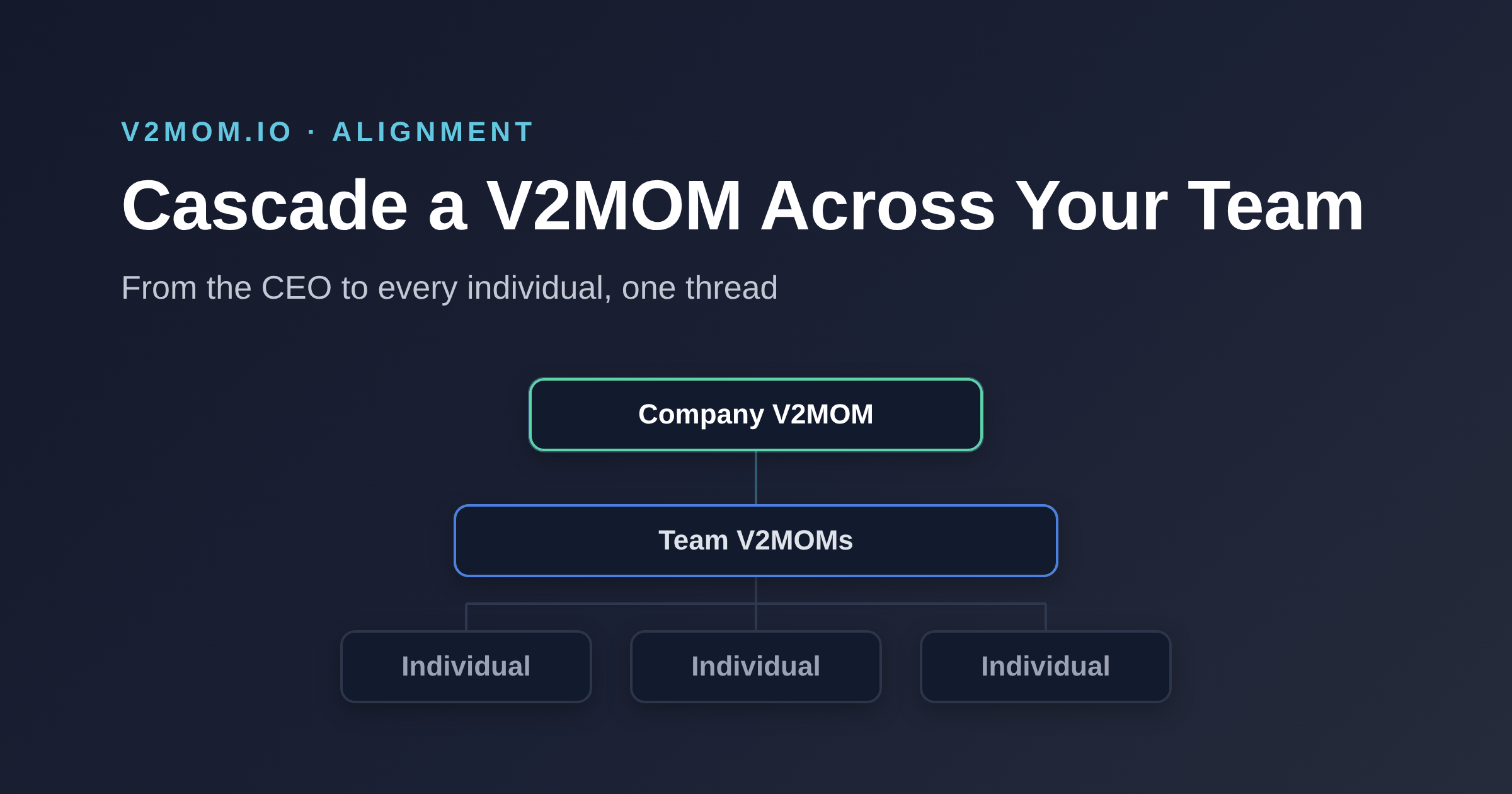
Cascading a V2MOM means creating linked V2MOMs at each level of the organization — company, team, and individual — so that each one's Vision and Methods support the level above it. The result is a single, unbroken thread from the CEO's strategy down to what one person does this week.
Why Cascading Matters
Most strategies fail in translation. Leadership sets a direction, but by the time it reaches the front line, everyone has their own interpretation. Cascading removes the guesswork: each person can point to the exact company goal their work supports, and leaders can see whether the plan actually reaches the ground.
How To Cascade a V2MOM, Step by Step
1. Write the company V2MOM first
This is the anchor. It should be broad enough to give teams room, but specific enough that a team can tell whether their work supports it. If you have not written it yet, start with our V2MOM framework guide and template.
2. Have each team write a V2MOM that supports it
A team's Vision should be a more specific version of the company's. Frequently, a company Method becomes a team Vision. For example, if the company Method is "launch in three new markets," the sales team's Vision might be "make our first market the strongest launch we have ever run."
3. Align Methods to the level above
Each team's Methods should be the concrete actions that deliver on the company's Methods. This is where strategy turns into execution — and where you can spot gaps (a company Method with no team owning it) or waste (team Methods that support nothing above).
4. Let individuals write personal V2MOMs
Each person writes a V2MOM whose Vision supports their team's. Their Methods are their real work; their Measures should visibly roll up into a team Measure.
5. Connect the Measures
This is the step most teams skip. Individual Measures should sum or ladder into team Measures, which ladder into company Measures. When they do, you can trace one number from the front line to the boardroom.
Common Cascading Mistakes
- Copy-paste cascading. If a team's V2MOM is just the company's reworded, it adds nothing. Each level should get more specific.
- Orphan Methods. A company Method that no team owns will not happen.
- Set-and-forget. Alignment decays. Without a review rhythm, cascaded plans drift apart within a quarter.
Keep the Cascade Alive
Cascading is not a one-time exercise. Review Measures on a regular cadence — weekly or monthly — and revisit the full cascade each planning cycle. Tools like V2MOM.io make the links visible, so anyone can see how their V2MOM connects to the company's in real time.
FAQs
What does it mean to cascade a V2MOM?
Cascading a V2MOM means creating linked V2MOMs at the company, team, and individual levels, so each one's Vision and Methods support the level above it — creating alignment from the CEO to the front line.
Where do you start when cascading?
Start at the top with the company V2MOM. It is the anchor that every team and individual V2MOM ladders up to.
How do team and company V2MOMs connect?
Often a company Method becomes a team's Vision, and the team's Methods are the concrete actions that deliver on it. Measures should roll up from individual to team to company.
How often should a cascaded V2MOM be reviewed?
Review Measures weekly or monthly and revisit the full cascade each planning cycle, typically quarterly. Alignment decays without a regular review rhythm.